Oncofertility connects cancer treatment with reproductive medicine, helping patients protect their future fertility through egg, embryo, or sperm freezing.
Genetic testing gives you information about your embryos before a transfer: which chromosomes are present, which inherited conditions are carried, and which embryo(s) your care team recommends transferring first. For many patients, that means less time waiting and less guessing. Fewer transfers before a pregnancy, fewer cycles spent on embryos unlikely to implant, and clearer answers if you have had a loss. Your physician will talk through whether it fits your situation before anything is sent to the lab. SCRC offers two genetic tests:
- Preimplantation Genetic Testing (PGT)
- Nucleus Embryo Testing
Preimplantation Genetic Testing (PGT)
What is PGT testing
PGT is a genetic look at your embryos. It can tell you whether an embryo has the right number of chromosomes, whether it inherited a condition that runs in your family, or whether a known rearrangement came through. It happens during your IVF cycle, after fertilization, and before any transfer. A few cells are taken around day five or six, from the layer that becomes the placenta and not the baby. Your embryos stay frozen in our on-site lab while the analysis runs, and results usually come back in one to two weeks. Your physician will run through the report with you, and together you choose which embryo to transfer first. Your physician will walk through whether testing fits your situation. These are the most common reasons patients consider it.
- You are 35 or older. The share of embryos with an abnormal chromosome count rises with egg age, so a count adds more information.
- You have had two or more losses. Recurrent miscarriages are often chromosomal, and PGT-A can identify which embryos carry that risk.
- Transfers have failed to implant. After one or more transfers without a pregnancy, testing helps separate an embryo issue from a uterine one.
- You carry an inherited condition. If carrier screening shows you and your partner carry the same recessive condition, PGT-M applies.
- There is a known chromosome rearrangement. A balanced translocation in either partner is the clearest indication for PGT-SR.
- You want fewer transfers. Some patients choose testing to prioritize embryos and shorten the path to a single healthy pregnancy.
The types of PGT testing
| Test | What it looks at | Detail |
|---|---|---|
| PGT-A | Chromosome count | Checks whether the embryo has 46 chromosomes. Extra or missing chromosomes are the most common reason an embryo fails to implant or a pregnancy is lost. This is the most frequently ordered of the three. |
| PGT-M | A single known condition | Looks for one specific inherited condition a parent carries, such as cystic fibrosis, sickle cell disease, or Huntington’s. Built as a custom test for your family, which adds some lead time before the cycle. |
| PGT-SR | Structural rearrangements | For patients with a known translocation or inversion, identifies embryos that inherited an unbalanced form of it. Usually follows a karyotype result. |
Book your consultation with our fertility physicians to learn more.
Nucleus Embryo Testing
What is it
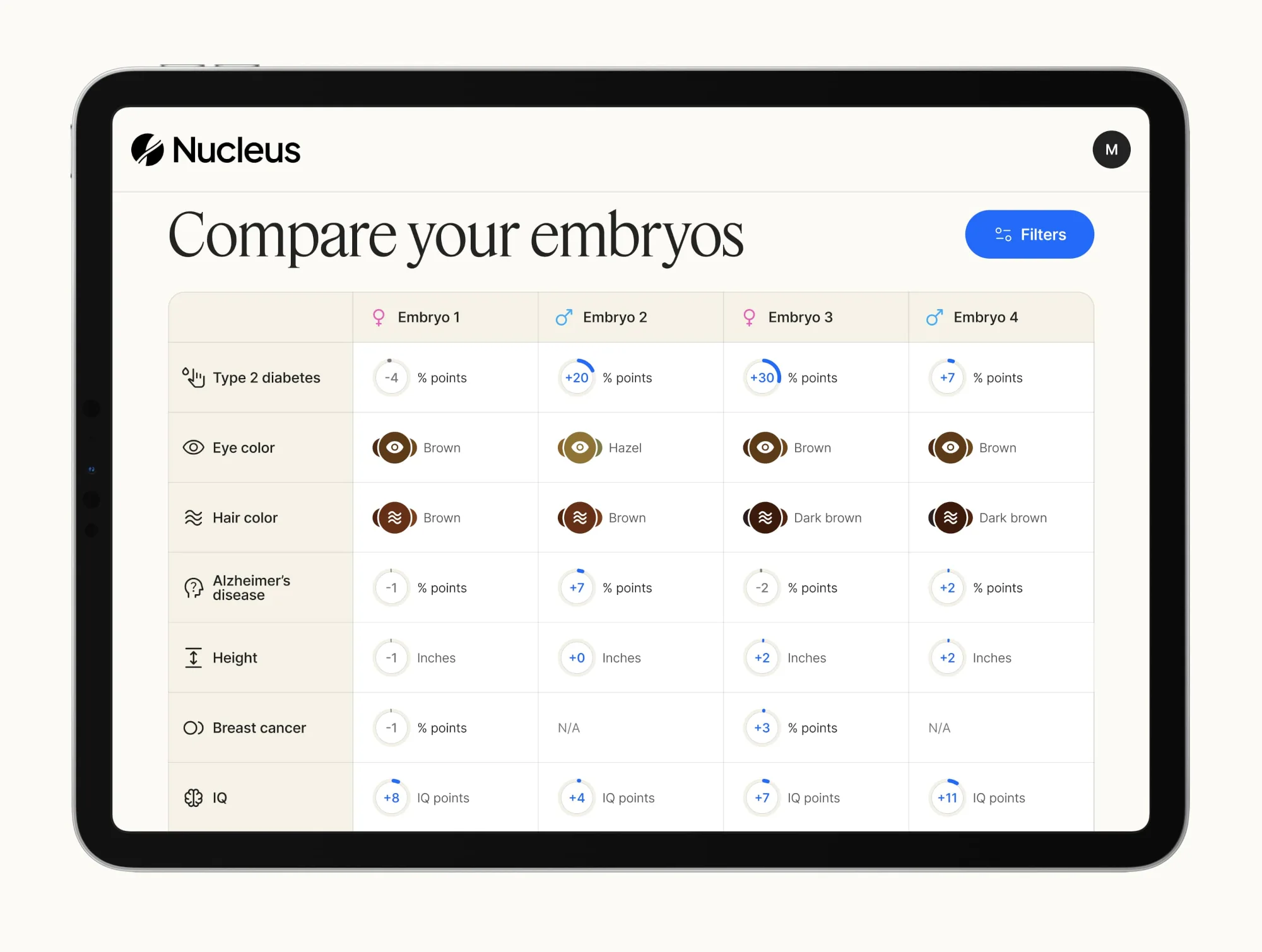
Nucleus Embryo encompasses advanced carrier screening (Nucleus Preview) and an analysis of your embryos’ genome from the same biopsy PGT already uses – requiring no additional procedures or biopsies for you. It returns carrier status across more than 2,000 rare inherited conditions, along with risk estimates for common conditions shaped by many genes at once, such as heart disease, endometriosis, and diabetes. It can also assess risk for hereditary cancer syndromes including hereditary breast and ovarian cancer syndrome and Lynch syndrome. The risk estimates for common conditions are probabilities, not diagnoses. An embryo with a higher score for a condition may never develop it, and a lower score is not protection. Predictive accuracy also varies by condition and by genetic ancestry. For that reason, you’ll always review your results at no additional cost with a genetic counselor to interpret the information based on your family history and values.
How is it different from standard embryo analysis?
Nucleus Embryo provides additional insights into disease risk and traits on top of standard testing, using the same biopsy.
| Test | Standard Screening | Nucleus Embryo |
|---|---|---|
| What It covers | Standard sex determination and chromosome count | Combination of advanced preconception testing with embryo analysis including sex determination and chromosome count |
| What it shows | Reviews ~300 rare single-gene disorders to flag for PGT-M testing | Reviews ~2,000 rare conditions within our carrier screening to flag for PGT-M testing |
| Additional analysis | Mainly based on what embryos look like under a microscope (morphology) | Delivers probabilistic risk for several common conditions and traits such as Alzheimer’s, breast cancer, height, IQ, and more |
When to consider it
Patients most often consider it when:
- They are already planning PGT and want a broader picture from the same biopsy.
- There is a family history of an inherited condition that standard carrier screening did not fully address.
- Hereditary cancer risk is a concern in either partner’s family. They want more information about their donor’s genetic profile.
- They’re looking for more insights about frozen embryos they have stored.
If you want to learn more, ask your clinical team or book a consultation.